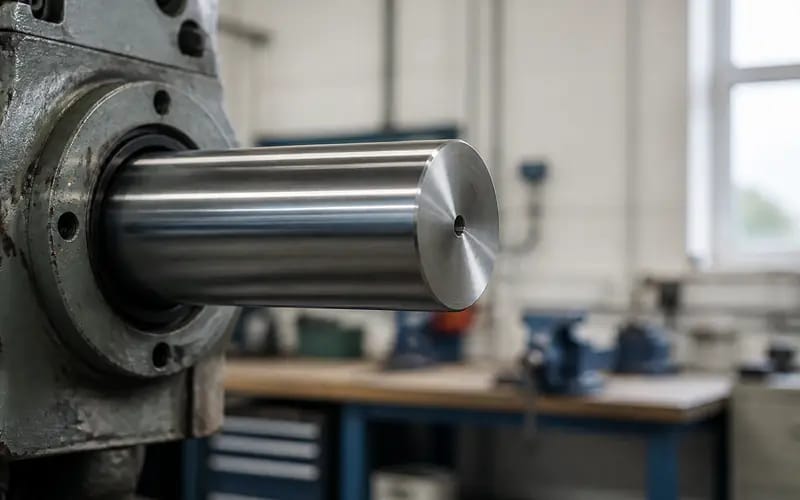
A coating that performs well on a static part can fail in weeks on a part that vibrates constantly. Therefore when selecting a surface finish for parts that flex or rub against other parts, special attention needs to be focused to the specific application.
Why Vibration Changes The Brief
Coating failures on static components typically occur due to abrasion or corrosion. Components subject to vibration, however, are susceptible to fretting wear. This is caused by minute amounts of movement between the faces of joints and interfaces, leading to fine wear surfaces. Additionally, cyclic stress is induced within any coating layer, which can cause fatigue cracking. For information regarding the causes of fatigue cracking within metal components subject to cyclic loading, please refer to the Institute of Mechanical Engineers’ website.
Hard Chrome And Its Trade-offs
Hard chrome can provide excellent wear resistance to shafts and rams etc., but suffers from repetitive sustained cyclic loading leading to fine micro-cracking of the chrome layer. This can then lead to fatigue failure. The chrome plating process also can cause hydrogen embrittlement of the base metal which can render the part more brittle than necessary. This embrittlement can be relieved by baking the part after chrome plating at a controlled temperature for a suitable period of time.
Electroless Nickel On Complex Shapes
Parts such as brackets, valve bodies, joints etc that are subjected to uneven vibration require a uniform coating on all surfaces. This is easily achieved with an electroless nickel coating which is a non-electroplating process and as such does not have the problems of thin areas on sharp turns and internal surfaces such as bores etc that can be encountered with some forms of electroplating.
Thermal Spray For Shafts And Bearings
Parts such as shafts, bearing journals, etc. are subject to constant fretting of surfaces, which is a problem that a thermal spray coating can alleviate. Thermal spray coatings are comprised of a variety of materials including tungsten carbide, and are applied by spraying molten or semi-molten material at high velocity onto a surface. Such coatings have good surface wear resistance, but it is essential to check the adhesion to the base material as well as the coating’s porosity, since a poorly adhered coating can peel off easily.
Zinc Nickel On Fasteners And Clips

On components such as fasteners and other components that are used in Clips, which are mounted onto vibrating assemblies, the principal requirement is to be able to sustain part torque and to resist corrosion. A suitable coating for these types of components is Zinc Nickel. The coating provides a suitable resistance to corrosion in a variety of tests including salt spray testing and produces a consistent surface which has a constant and reproducible coefficient of friction.
For Surface Treatments, visit Poeton Surface Treatments.
Hard Anodising On Aluminium Parts
While hard anodising forms a wear resistant layer on aluminium components, the oxide coating that is formed is very brittle. Fine cracks can easily appear in the coating on parts that are subject to high frequency, low amplitude vibration. The aluminium beneath the coating may be perfectly sound but the coating will split and flake. This is more of a problem with coating thickness and sharp internal corners which concentrate stress in these areas and can easily cause coating failure.
Shot Peening Before Coating
The most effective surface treatment of all is Shot Peening. This involves firing small round media at high velocity onto the surface of the part to introduce into the surface layers of the metal large amounts of compressive stress. This delayes the onset of fatigue cracking and allows extended working life of parts under cyclic loading. Surface treatment prior to coating is a standard practice within the Aerospace and Automotive industries and should be asked for by potential suppliers of surface treatment.
Testing The Finished Part
When selecting a coating, the only true method to qualify the finish to certain areas of wear is to test the finished part in fatigue or vibration testing. It is common practice to perform such testing on critical parts that cannot be easily replaced or are of safety critical design. This type of testing can be incorporated into the specification for the part.
Choosing the best finish for parts that vibrate, flex or rub against other parts is not just about choosing the hardest and best corrosion resistant coating. It’s also about understanding the known weaknesses of the coatings and matching them to the movements of your parts.
